Kuldhara Village Jaisalmer – History, Legend, Entry Fee, Timings
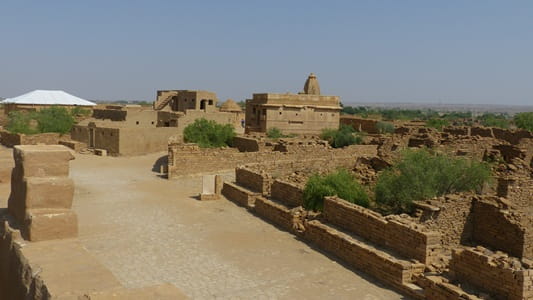
The desert doesn’t explain itself. It simply holds what was left behind — stone walls bleached by two centuries of sun, roofless houses arranged along wide dusty lanes, a temple with inscriptions that archaeologists are still reading carefully. Kuldhara, 18 kilometres from Jaisalmer in Rajasthan’s Thar Desert, was a functioning village until 1825. Then, one night, it wasn’t. Around 1,500 Paliwal Brahmin families from Kuldhara and 83 surrounding villages disappeared into the desert without trace — and nobody has lived here since.
Whether that disappearance was a protest, a flight from oppression, a response to environmental collapse, or some combination of all three, the ruins they left behind are genuine and worth seeing. The ghost narrative is a tourism layer on top of a real historical mystery. Both are part of what Kuldhara is now.
Kuldhara Village Jaisalmer – Quick Overview
| Detail | Information |
| Location | 17–21 km west/southwest of Jaisalmer, Rajasthan – 345001 |
| Established | 1291 CE by Paliwal Brahmins |
| Abandoned | Around 1825 CE |
| Current Status | Protected heritage site under Archaeological Survey of India (ASI) |
| Entry Fee | ₹10 per person; ₹50 car parking charge |
| Timings | 8:00 AM – 6:00 PM (Mon–Sat); gates closed after dark |
| Nearest Airport | Jaisalmer Airport – approx. 22–23 km |
| Nearest Railway Station | Jaisalmer Railway Station – approx. 25–26 km |
| How to Reach | Taxi/cab from Jaisalmer city (30–35 minutes); enroute Sam Sand Dunes |
| Best Time to Visit | October to March |
| Time Needed | 1–2 hours |
| Ideal For | History, photography, Jaisalmer day trips, folklore enthusiasts |
History of Kuldhara Village Jaisalmer
Kuldhara was founded in 1291 CE and was part of a network of 84 villages settled and managed by the Paliwal Brahmins — a highly organised community that had migrated from Pali in northern Rajasthan. The Paliwals were not merely farmers. They had developed sophisticated systems of water harvesting, agriculture, and trade that allowed them to thrive in one of the harshest desert environments on the subcontinent. Kuldhara was prosperous. The village’s sandstone architecture — wide planned lanes, layered houses with courtyards, a functioning temple — reflects a community that was building for permanence.
That permanence ended in the early 19th century. The commonly told version of events involves Salim Singh, the Diwan (prime minister) of the Jaisalmer State, who reportedly demanded the daughter of Kuldhara’s village chief in marriage. When the Paliwals refused, threatening heavy taxation and persecution, the community’s councils across all 84 villages met in secret and made a collective decision: leave, rather than submit. They departed overnight, leaving everything behind, and reportedly cursed the land so that no one would be able to settle there again.
Historians and archaeologists note that the record is not this simple. Several alternative explanations have been seriously considered: prolonged drought and failure of the water management systems that sustained the community; a major earthquake that made the structures uninhabitable; the broader decline of the trade routes that the Paliwals had profited from for centuries. The truth is almost certainly layered — Salim Singh’s documented reputation for cruelty and heavy taxation likely compounded other pressures that were already making the village difficult to sustain. The fact that 84 villages moved simultaneously, rather than just one, suggests a coordinated political response rather than purely environmental migration.
What no serious account disputes: Kuldhara has been uninhabited since approximately 1825. Two centuries of Thar Desert wind have done the rest.
What to See at Kuldhara Village Jaisalmer
The Ruins and Lane Architecture
The entry gate is the first thing visitors encounter — a sandstone archway that marks the boundary between the road and the abandoned settlement. Beyond it, Kuldhara’s planning becomes immediately apparent. The lanes are wide and straight. Houses are arranged in organised rows. Even in partial ruin, the spatial logic of the community is readable. This was not a haphazard settlement; it was a planned town, and the Paliwal Brahmins’ architectural sophistication is visible in every standing wall.
Most structures are roofless, walls worn to varying heights by erosion and time. Some houses have been partially restored to show visitors the original layout: entrance courtyards, separate kitchen spaces, sleeping rooms, storage areas. Walking through them gives a genuine sense of how the village functioned.
The Ancient Temple
A temple sits within the village complex and is among the more intact surviving structures. Archaeological inscriptions found inside it have provided researchers with some of the most direct evidence about the Paliwal community’s practices and the settlement’s timeline. The temple remains a point of interest both for its historical significance and for its unusual presence in an otherwise completely abandoned landscape.
The Parched Kakni Riverbed
To the east of the village lies the dry bed of the Kakni river — a detail that several historians point to as quietly significant. The disappearance of reliable water in this arid region may have been as decisive a factor in the abandonment as any political crisis. Standing at the edge of the dry riverbed and looking back at the ruins, both the beauty and the precariousness of this settlement become simultaneously clear.
Photography
Kuldhara is frequently visited by photographers, and for good reason. The combination of golden sandstone ruins, desert light, and total absence of contemporary clutter makes it one of the more rewarding architectural photography locations in Rajasthan. The best light is early morning shortly after opening or in the late afternoon before closing. Midday in summer is harsh and flat.
Film Location
Kuldhara’s atmosphere has attracted Bollywood productions over the years. Agent Vinod is among the films that used its ruins as a location. The Fear Files television series and other paranormal-themed productions have shot episodes here. The village’s combination of genuine age and photogenic desolation makes it a natural draw for filmmakers working in both the thriller and historical genres.
How to Reach Kuldhara Village from Jaisalmer
Kuldhara is 17–21 km from Jaisalmer city — a 30–35 minute drive on a well-maintained road. It sits on the route toward Sam Sand Dunes, which makes it a natural pairing on a single day’s itinerary: Kuldhara in the morning or early afternoon, Sam Sand Dunes for the sunset camel ride.
The most practical way to reach Kuldhara is by taxi or cab from Jaisalmer. Most hotels and guesthouses in Jaisalmer can arrange this; drivers will typically offer a combined Sam–Kuldhara itinerary. Private vehicles can drive directly to the site and pay the ₹50 car parking charge at entry. Auto-rickshaws are an option for solo or paired travellers willing to negotiate. Public buses operate on this corridor but are infrequent and unreliable for timing purposes.
From Jaisalmer Railway Station, the village is approximately 25–26 km. From Jaisalmer Airport, approximately 22–23 km. No metro or rail access exists to the village — the entire Jaisalmer district relies on road transport for internal movement.
Best Time to Visit Kuldhara Village Jaisalmer
October through March is the window. Rajasthan’s desert climate means that May through August brings temperatures that make extended outdoor exploration genuinely punishing. The ruins are entirely open-air with no shade infrastructure, so summer visits are best kept short and early morning only.
Winter evenings in the Thar are cold — bring an outer layer for any late-afternoon visit between November and February. October and March offer the best combination of comfortable temperature and clear skies. The monsoon (July–September) is not peak Rajasthan visiting season, though Jaisalmer receives relatively little rainfall compared to eastern Rajasthan.
Practical Visitor Information
Entry is ₹10 per person and ₹50 for car parking. The site is managed by the ASI. Timings are 8:00 AM to 6:00 PM Monday through Saturday. The gates are closed after dark — this is non-negotiable regardless of the haunted-village tourism narrative. There is no formal on-site accommodation; visitors return to Jaisalmer for the night.
A few honest observations from visitor accounts worth noting: guides at the entrance can be persistent and occasionally overcharge; the site is walkable and well-documented enough that a guide is not necessary for most visitors. Some sections collect litter, which detracts from the experience in spots. The site is genuine and worth an hour to two hours; those expecting a managed museum experience will find it more raw than curated, which is also part of its character.
FAQs About Kuldhara Village Jaisalmer
Q1. Why was Kuldhara village abandoned?
A: The most widely told explanation is the Salim Singh legend — that the Diwan of Jaisalmer demanded the village chief’s daughter in marriage, and the entire Paliwal Brahmin community across 84 villages chose mass exodus over submission. Historians also point to possible water scarcity due to drought and the drying of the Kakni river, earthquake damage, and declining trade routes as contributing factors. The abandonment likely reflects several pressures converging simultaneously rather than a single cause. No one has definitively resolved the question, which is part of why the site continues to draw serious scholarly and popular interest.
Q2. What is the entry fee for Kuldhara village Jaisalmer?
A: Entry is ₹10 per person. If you arrive by car, an additional ₹50 parking charge applies. The site is managed by the Archaeological Survey of India (ASI). Always confirm current fees at the gate, as charges are occasionally revised.
Q3. What are Kuldhara village timings?
A: The site is open 8:00 AM to 6:00 PM, Monday through Saturday. Gates are closed after sunset; no overnight stays or post-dark visits are permitted, irrespective of the haunted village reputation. Timings may vary during public holidays or special events — confirm with local operators before visiting.
Q4. How far is Kuldhara from Jaisalmer and how do you reach it?
A: Kuldhara is 17–21 km from Jaisalmer city, approximately 30–35 minutes by road. The most practical route is by taxi or cab from Jaisalmer; most hotels arrange this, often combined with a Sam Sand Dunes visit on the same day. Private vehicles can drive directly to the site. No public metro or rail access exists — all travel is by road.
Q5. Is Kuldhara village actually haunted?
A: Scientifically, there is no verified evidence of paranormal activity at Kuldhara. The haunted reputation is rooted in the legend of the community’s curse before departing, and has been amplified by paranormal investigators, television productions, and tourism marketing over recent decades. The site is eerie in the way that any genuinely abandoned 200-year-old settlement in a silent desert landscape would be — that atmosphere is real. The ghost stories are folklore layered on top of an actual historical mystery, which is itself interesting enough to warrant a visit.